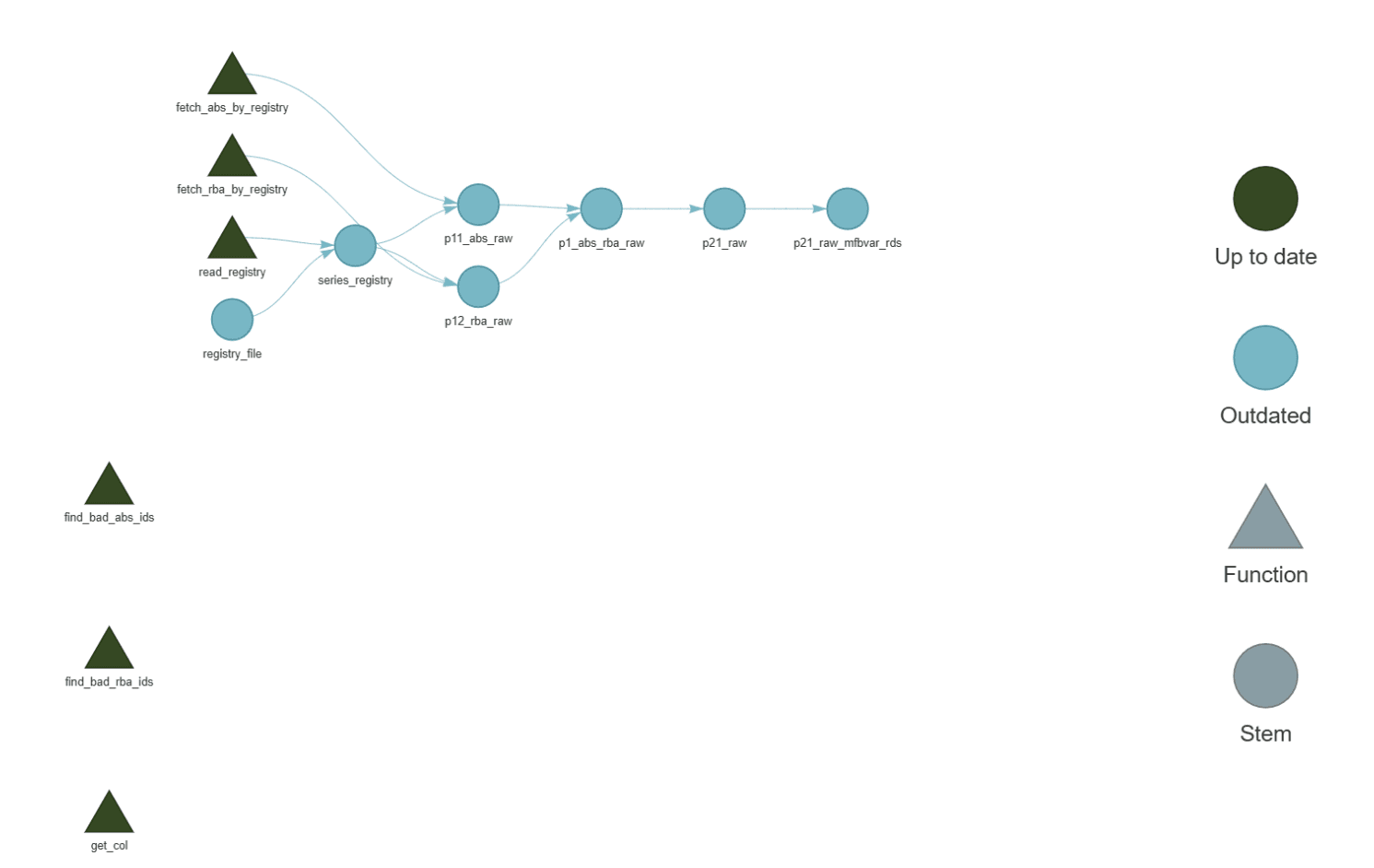
Built an explicit targets graph from registry loading through ABS and RBA ingestion to a saved modeling artefact.
CompletedBuilt 2025-11
Treasury Nowcasting
A registry-driven nowcasting system that turns ABS and RBA releases into reproducible state and national output inputs, then tests how far a coherent Bayesian estimator can actually be trusted.
RPythontargetstarchetypesreadabsreadrbaNumPypandasSciPyQuarto
Treasury Nowcasting
This project split cleanly into two parts. The data pipeline produced a transparent, reproducible base for state and national output estimation; the Bayesian estimation layer pushed into mixed-frequency coherence work that never resolved into a stable posterior.
The Brief
GSP nowcasting is an attempt to estimate state output before every input series has fully settled. The end goal was not a generic macro dashboard; it was a coherent state-and-national system where Gross State Product, State Final Demand, and higher-frequency macro indicators could be handled in one workflow without losing track of how the pieces relate to each other.
That matters for anyone who needs an earlier read on economic activity than the annual GSP releases provide. The project documents that need through snapshot construction, ragged-edge handling, and a national measurement equation tied back to weighted state growth rather than through a disconnected state-by-state exercise.
The Data & Pipeline
The strongest part of the project is the ingestion and preparation layer. The
active targets graph is explicit: one step defines the series schema,
another loads it, then separate stages pull ABS and RBA series, combine them,
clean them, and write out a modeling-ready artefact. That separation matters
because each step can be inspected on its own instead of being buried inside a
notebook.
The active schema covers a mixed panel. On the ABS side it includes national
GDP and CPI, monthly goods imports and exports, business turnover, quarterly
State Final Demand for every state and territory, and annual Gross State
Product current-price series for NSW, VIC, QLD, SA, WA, TAS, NT,
and ACT. On the RBA side it pulls the cash rate target, trimmed mean
inflation, total credit, the trade-weighted index, and commodity prices. The
surrounding notes also document the ABS and RBA selection workflow and example
catalogue pulls used during sourcing.
What makes the pipeline worth highlighting is the amount of standardisation it bakes in before any model sees the data. Both source pulls work from the same registry. The preparation layer normalises dates and frequency labels, fills missing frequency information, adds consistent state identifiers, drops noisy optional columns, and reorders the output into a stable layout. The quarterly tooling goes further: it first rolls daily and weekly data up to monthly values, then aggregates to quarter using clear rules such as sums, last observations, compounded growth, or means. It also tracks how stale each series is and defines several snapshot cut points so the same quarter can be viewed under different information sets.
It is not perfectly clean end to end yet: the active code expects the schema in a different location from where the checked-in version currently sits, and the pipeline writes a different intermediate format from the one the report and notebooks read. But the core idea survived contact with the project. The ingestion, cleaning, and quarterisation logic is legible, separable, and rerunnable.
The Modeling Arc
The first phase was exploratory. In the Python notebooks, the national series,
four exogenous macro series, eight state series, and annual GSP weights were
forced onto a common quarterly intersection running from 1991Q2 to 2025Q4.
That pass did not claim the coherence link worked automatically. The
weighted-state combination only correlated with the national series at about
0.518, with explained variance around 0.268, and the best lag search still
landed at zero. Period correlations improved in later windows, but the notebook
conclusion was effectively that the national measurement block still had to be
modelled rather than assumed away.
That led to the Bayesian VAR direction. The report and estimation notes make the aim explicit: a latent state-growth VAR, a national measurement equation tied to weighted contemporaneous state growth, Minnesota shrinkage, Dirichlet-Laplace sparsity, stochastic volatility, and blocked Gibbs plus FFBS to hold the system together. This was not Bayesian styling for its own sake; it was an attempt to keep state-national coherence inside the model instead of repairing it after the fact.
The next beat was the mixed-frequency BVAR work in R. That code expects monthly time-series inputs, pads quarterly variables with missing values between quarter ends, enforces a weekly-to-monthly-to-quarterly ordering, standardises the inputs, and then tries several variance settings. In other words, it was trying to solve the exact problem the simpler quarterly notebook could not: how to keep mixed frequencies, coherence, and shrinkage in one estimation routine without the whole system becoming numerically fragile.
After that, the implementation path shifted into Python. The notebooks run under a PyMC-oriented environment and the estimation notes mention a missing-value idea, but the committed code does not contain a finished PyMC model or sampling workflow. The pivot is better described as Python plus custom blocked-Gibbs and forward-filtering backward-sampling code than as a finished PyMC model. The Python phase kept the same economic target and the same coherence structure, but it implemented them through notebook-local samplers instead of a completed package.
The closest thing to a paper replication in the project is the attempt to operationalise the cited mixed-frequency Bayesian nowcasting literature.
Where It Broke
The clearest mechanical break recorded in
the project is: "Highly collinear data pairs causing Cholesky decomposition
failure, followed by matrix out of bound errors." Furthermore, after lag expansion, the feature matrix contained near-duplicate
columns, which turned the mixed-frequency system into a multicollinearity
problem before it could become a trustworthy nowcast. Around that, the wider
audit kept pointing to the same cluster of issues: identification and scaling,
sensitivity to prior choices, sampler errors, and timing mismatches. The end
result showed up in the checks as well as the code. One of the
evaluations missed the project's own calibration thresholds on correlation
(0.674 against a >= 0.70 target) and 80% posterior predictive coverage
(0.744 against a 0.75-0.85 target), while zero states landed inside the
target coverage band. That is why the paper-inspired
version proved brittle here. Too much structural complexity was being asked to
settle at once. For this to work, the project's own prescription is the right one:
reduce dimensionality, use more structured priors, build the model in stages
from fixed-volatility VAR upward, and only reintroduce full mixed-frequency and
stochastic-volatility machinery after a simpler version converges.
What I Learned
- A registry-driven
targetsgraph can still produce usable economic infrastructure even when the estimator above it is unsettled. The fetch and clean path stayed inspectable because each step had one job. - Mixed-frequency coherence is a modeling constraint, not just a data-wrangling detail. Annual GSP anchors, quarterly State Final Demand, and monthly macro indicators can live in one project, but their timing mismatches do not disappear because the tables line up.
- Lag expansion can quietly manufacture near-duplicate columns. In this project, that showed up as multicollinearity, Cholesky failure, and matrix-bound errors rather than as a polite warning.
- Calibration checks have to be treated as hard gates. A model that preserves coherence numerically but misses its own coverage and correlation targets is not ready.
- If the full MF-BVAR-SV stack will not settle, the right move is down, not sideways: fewer series, stronger structure, and staged complexity before scaling back up.
Honest Limitations
The current project scenario is not a clean one-command bridge from data pull to final estimation. The final notebook cells depend on in-memory objects that are not preserved in the file tree. Those are repo-level limitations on top of the modeling failure, and they matter for anyone trying to rerun the full stack exactly as saved.
WHY IT EXISTS
To build a reproducible state and national output pipeline and test whether a coherent Bayesian framework could estimate Gross State Product under incomplete quarterly information.
WHAT WAS HARD
Keeping annual GSP anchors, quarterly State Final Demand, and monthly macro indicators aligned without creating the collinearity, scaling, and timing problems that later broke estimation.
WHAT I'D DO DIFFERENTLY
I would build complexity in stages: fixed-volatility VAR first, then stochastic volatility, then mixed-frequency structure, with more structured priors and lower dimensionality before scaling back up.
Technical Notes
Standardised dates, frequencies, seasonal-adjustment flags, and state codes before quarterisation so the panel could be inspected and rerun consistently.
Added ragged-edge and snapshot tooling for `T+15`, `T+45`, and `T+75` information cuts rather than treating every quarter as fully observed.
The Bayesian MF-BVAR-SV work preserved state-national coherence numerically, but it never reached the project's own calibration thresholds or a stable posterior.